Test riding a cruiser? What to check in the parking lot before the money moves
Reclaim CA Higher Ed- Subject
- Choosing an upright, comfort-oriented bicycle for short casual riding, covering frame geometry, gearing, braking and the real cost of getting one road-ready
- Editor
- The Reclaim CA Higher Ed team
- Subject
- Choosing an upright, comfort-oriented bicycle for short casual riding, covering frame geometry, gearing, braking and the real cost of getting one road-ready
The backward lean of the seat tube on a cruiser slides the saddle behind the cranks, changing the direction your leg pushes. It is the single biggest reason an upright feels unfamiliar to someone coming off a hybrid.
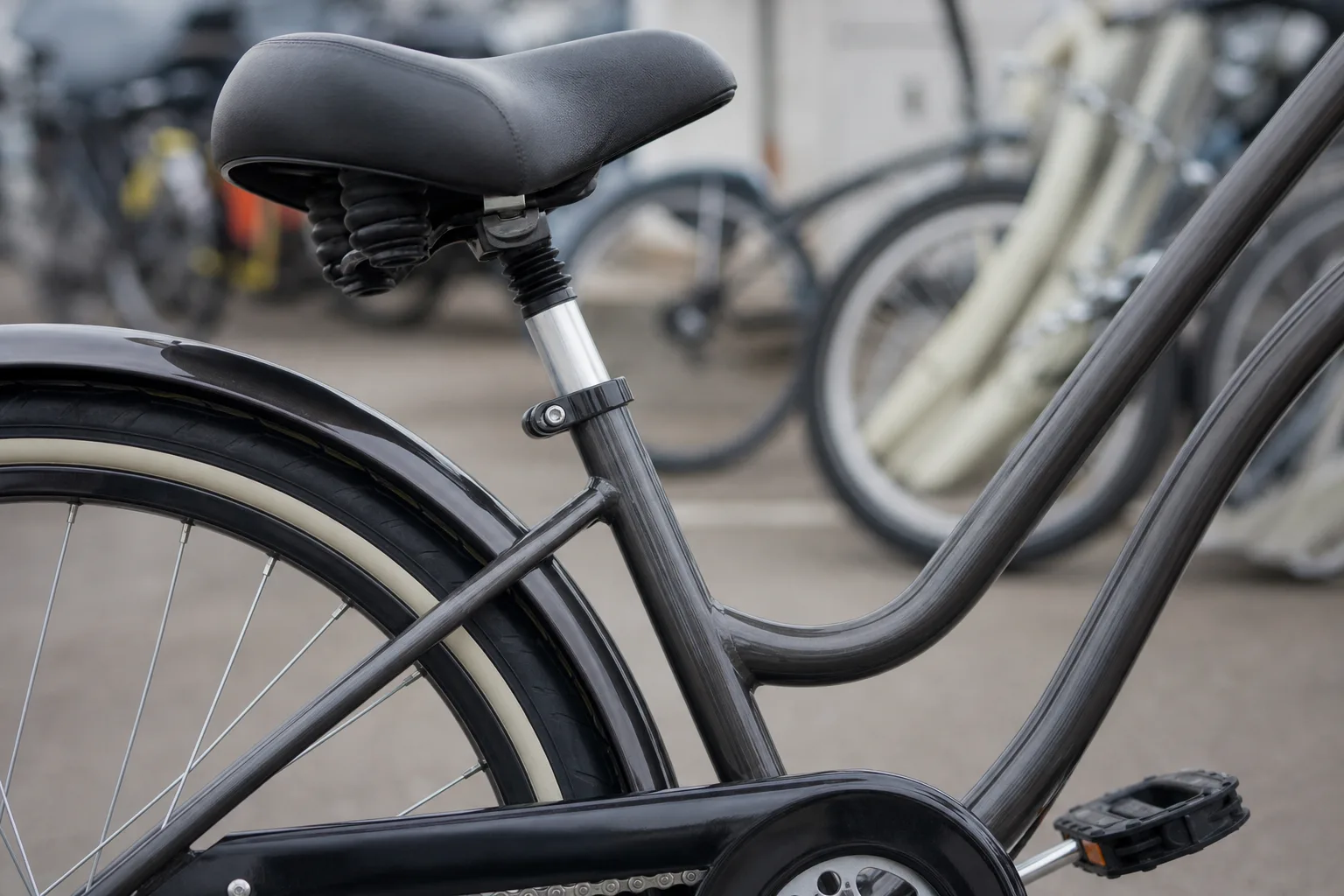
The first fifty feet on an unfamiliar upright bike tell you something real, but not what most riders think they are hearing. The wobble, the vague steering, the sense that your legs are pushing a wall: almost none of that is a verdict on the bike's quality, and most of it comes from two numbers, the seat tube angle and the saddle height, that were set by whoever last touched the thing. A careful reader of a bicycle checks those two before deciding anything else. They are also the two that a shop can and cannot change, respectively, and knowing which is which saves a bad purchase.
The seat tube leans back, and your legs move with it
A road or hybrid frame typically puts the seat tube close to vertical, so the saddle sits more or less above the bottom bracket and your hip, knee and pedal stack into a compact column. A cruiser or a traditional upright leans that tube backward, sometimes dramatically, which slides the saddle rearward relative to the cranks and opens the angle at your hip. The consequence everyone notices is the relaxed posture. The consequence that matters more is that your leg now pushes forward at the pedal rather than down through it, which recruits different muscles and feels weaker at first even when it is not.
That rearward saddle position is also why the wheelbase runs long. Chainstays stretch to keep your heels clear of the rear wheel, the front end pushes out for stability, and the whole bike becomes reluctant to turn quickly. On flat streets at eight or nine miles per hour, that reluctance reads as calm. In a tight parking lot at walking pace, the same geometry reads as a barge, and riders who test-ride only between parked cars often talk themselves out of a bike that would be pleasant on the errand they actually ride.
Foot flat on the ground is a stopping position, not a pedaling one
The traditional setup, both feet flat on the pavement while seated, is comforting and it is also expensive in effort. It forces the saddle roughly two to four inches below where your leg wants it, so the knee never comes close to straightening at the bottom of the stroke, and you spend the whole ride pushing from a permanent half-squat. The cost shows up as burning quadriceps on the mildest grade and a sore front knee after a week. Nothing about upright riding requires it. The bike will still be an upright bike with the saddle raised.
The useful compromise: set the saddle so your heel just reaches the pedal at the bottom with the leg straight, which puts a slight bend in the knee when the ball of the foot is on the pedal, then decide separately how you will stop. Most riders learn within a day to slide forward off the saddle onto the top tube at a light, which is what riders on every other kind of bike do. If sliding forward is not workable, a step-through frame with a low top tube gives you the same dismount without dropping the saddle, and that is a frame choice, not an adjustment.
Ten minutes in the lot, before anything is signed
Straddle the bike first, both feet flat, and look for clearance between you and the top tube. An inch or two is fine; contact means the frame is too big regardless of what the size sticker says. Then check the seatpost: pull it up to a proper pedaling height and see whether the minimum insertion line is still buried in the frame. If the post runs out before your leg is right, ask whether a longer post fits, because that is a cheap fix and a common one on boxed bikes sold with short posts.
Ride it with the saddle set properly, not as delivered. Roll fifty feet, then a slow figure eight, then a stop from moderate speed with each brake alone. Listen for the bottom bracket, feel for a crank arm that flexes, and check whether your knee tracks straight rather than swinging out, which usually means the saddle is still too low. The Consumer Product Safety Commission oversees bicycle safety requirements for bikes sold in the United States, and a shop assembly is where those requirements get verified rather than assumed.
What a shop can change, and what it cannot
Saddle height, saddle fore and aft position, handlebar rotation, stem height on a quill or a spacer stack, grip choice, tire pressure and brake reach are all adjustable, most of them in the same visit, several of them for the price of labor alone. Seat tube angle, wheelbase, standover and reach to the bars are the frame, and they are fixed. If the bike feels wrong after the adjustable items are set correctly, the frame is the wrong frame, and no amount of parts will argue with that. Knowing the boundary lets you negotiate for the fixes worth paying for.
The bike that felt sluggish at the curb often turns out to be the bike with three inches of saddle missing. Raise it, ride the same fifty feet again, and judge it then.